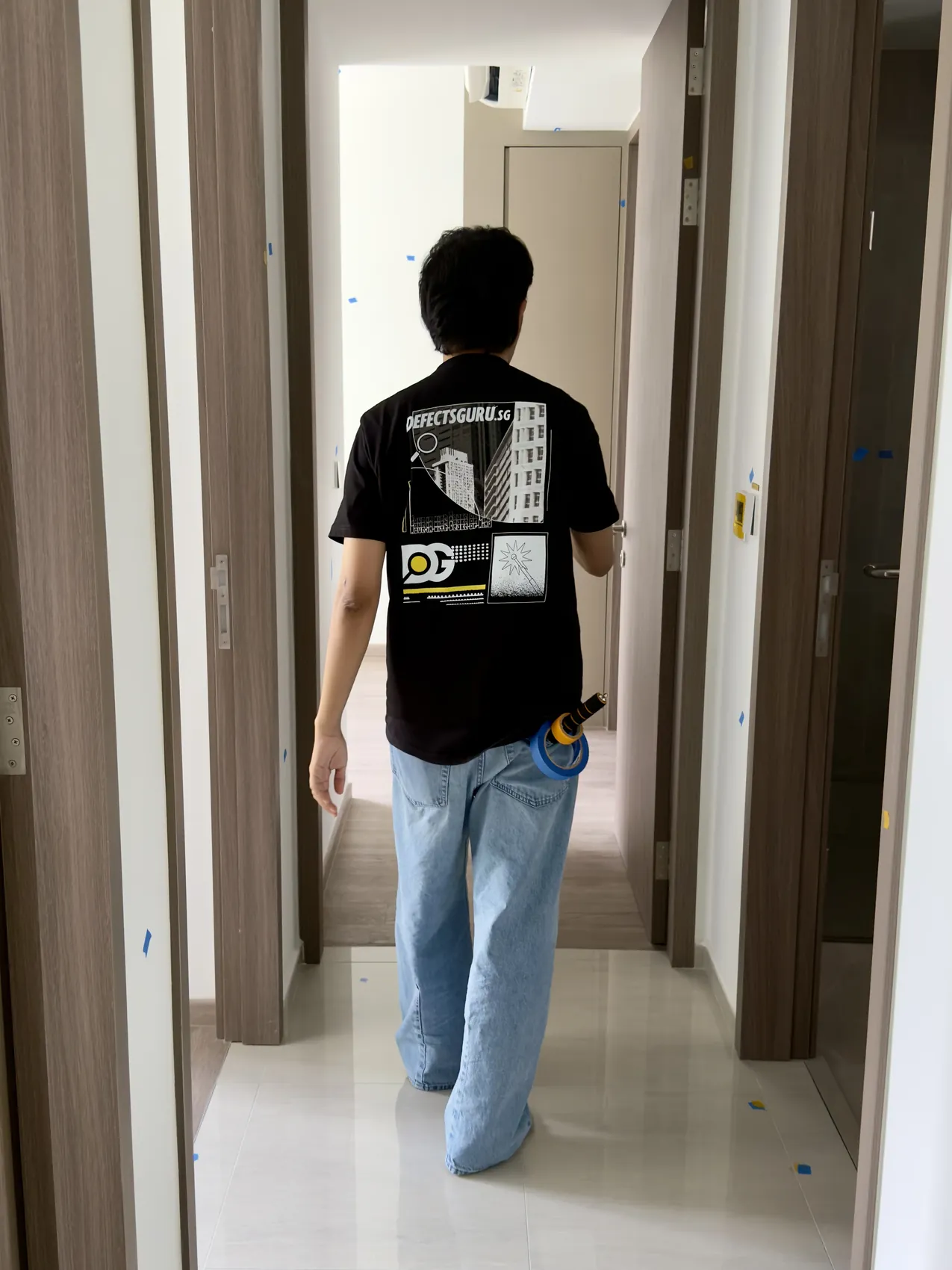
Condo & EC Handover: What to Watch For
TOP, the 12-month defects liability period, and the developer-specific defects a BTO checklist misses — plus exactly what to do if your developer drags their feet.
A private condo or EC handover runs on a different rulebook from a BTO. You are dealing with a developer, not HDB; your rights live in a contract, not a public scheme; and the building has whole categories of defect — balconies, M&E risers, shared seals — that an HDB checklist never mentions. Here is what to watch for, and the leverage you actually hold.
The short version
- You collect keys and inspect only after BCA issues the Temporary Occupation Permit (TOP).
- Your defects liability period is 12 months, fixed by the standard Sale & Purchase Agreement.
- On written notice, the developer must make good a defect within one month.
- If they fail, you can give a further 14-day notice, then engage your own contractor and recover the cost.
- Condo defects cluster around wet areas, balconies, windows, aircon ledges and M&E — inspect those hardest.
TOP, CSC and the day you get your keys
You can only legally occupy a new building once it has a Temporary Occupation Permit (TOP) or a Certificate of Statutory Completion (CSC). BCA issues a TOP when a development is suitable for occupation but still has outstanding items with some technical agencies; the CSC comes later, once every statutory requirement is cleared.1
In practice, once TOP is issued and you have paid the progress payment due on TOP, the developer tells you how to collect keys. Only then can you inspect your unit, the housing project and the common property — and report any defects to the developer for rectification within the defects liability period. This is the moment a professional condo defect check earns its keep.2
Your 12-month window — and where it comes from
The developer is obliged to rectify any defect in your unit, the common property or the housing project that becomes apparent within 12 months — running from the date the developer delivers vacant possession, or the 15th day after you receive notice that TOP has been issued, whichever is earlier.2
This is not goodwill — it is clause 17.1 of the standard-form Sale & Purchase Agreement prescribed under the Housing Developers Rules. Licensed developers must use that standard S&PA, and it cannot be amended without the Controller of Housing’s approval, so the same 12-month obligation applies uniformly across new private homes.3,4
How to notify the developer — and what if they stall
Report defects to the developer in writing. Under the prescribed S&PA, the developer must make good the defect within one month of receiving your notice.5
If the developer fails to act, you are not stuck. The S&PA lets you give a further 14 days’ notice; if the work still is not done, you may engage another contractor to carry out the rectification and recover the cost from the developer — including, as a remedy of last resort, by deducting it from the sum held by the Singapore Academy of Law as stakeholder for the developer, following the procedure and serving a notice of deduction.5,2
The condo-specific defects to hunt
Everything in a BTO checklist still applies — cracks, hollow tiles, paint, doors, sockets. But private units add finishes and systems that fail in their own ways. Inspect these hardest, because they are the expensive ones.
- Flood-test every bathroom and the yard: water must drain to the trap with no pondingHigh
- Continuous silicone at all floor-wall joints, around the WC, basin and shower screenHigh
- No damp patches, efflorescence or musty smell on walls shared with wet areasHigh
- Marble or homogeneous tiles level, unstained and free of hollow soundMed
- Balcony falls toward its drain; no ponding and a clear, unclogged outletHigh
- Sliding doors and windows glide, lock, and seal with intact gaskets — no draught or gapHigh
- No water stains below windows or the balcony door after rain (a sign of seal failure)High
- Glass free of scratches and chips; frames undented and properly caulkedLow
- Aircon ledge and drip tray drain freely — no water stains hinting at past overflowHigh
- Every power point live (test with a charger) and correctly earthedHigh
- All light points work; distribution board labelled and the safety trip testedMed
- Installed points and fittings match what the S&PA specifies for your unitMed
- Corridors, lift lobby and carpark finishes on your access route — cracks, leaks, stainingLow
- Lift levelling and door operation at your floorMed
- Shared walls and ceilings adjoining your unit free of seepageHigh
Document like you might need it later
Because your remedy is contractual, your paperwork is your power. Photograph every defect with something for scale, note the precise location, and submit one consolidated, dated list to the developer well inside the 12-month window. If you ever reach the 14-day-notice or recovery stage, that record is what proves your case.5
Frequently asked
How long is the defects liability period for a new condo or EC?
Twelve months. It runs from the date the developer delivers vacant possession of your unit, or the 15th day after you receive notice that TOP has been issued, whichever is earlier. The developer must make good defects that become apparent in that window.
What is the difference between TOP and CSC?
A Temporary Occupation Permit (TOP) lets you occupy the building even though some items with technical agencies are still outstanding. A Certificate of Statutory Completion (CSC) is issued later, once the development has met all relevant statutory requirements. You collect keys and inspect after TOP.
What can I do if the developer does not fix my defects?
Under the standard S&PA, the developer must make good a defect within one month of your written notice. If they fail, you can give a further 14 days’ notice, then engage another contractor and recover the cost from the developer — including, as a last resort, from the stakeholder sum held by the Singapore Academy of Law, following the S&PA procedure.
Can I report defects in the common property, not just my unit?
Yes. The developer’s obligation covers defects in your unit, the common property and the housing project that become apparent within the 12-month period, so issues like seepage on shared walls or lift faults on your route can be reported.
Sources & references
Every link below was checked against the live source. Regulations change — confirm specifics for your project before relying on them.
- 1Application for TOP / CSCBuilding and Construction Authority (BCA) — A TOP or CSC is legally required to occupy a building; TOP permits occupation with outstanding technical-agency items, CSC confirms full statutory compliance.
- 2URA Home Buyers’ Guide (5 Sep 2025)Urban Redevelopment Authority (URA) — Defines the 12-month defects liability period, the developer’s obligation to rectify, recovery from the Singapore Academy of Law stakeholder sum, and dispute-resolution guidance.
- 3Buying Property (Residential)Urban Redevelopment Authority (URA) — Keys and inspection only after TOP; report defects within the 1-year DLP; mandatory standard-form S&PA that cannot be amended without the Controller of Housing’s approval.
- 4Revised Edition of the Housing Developers Rules (Controller of Housing Circular)URA · Controller of Housing — Reproduces clause 17.1 of the prescribed S&PA setting the 12-month defects liability period from receipt of the Notice of Vacant Possession.
- 5Court of Appeal judgment [2020] SGCA 86Supreme Court of Singapore — Sets out clause 17 mechanics: make good within one month of notice; on failure, a further 14-day notice, then the purchaser may rectify and recover the cost.